
How to Check Criminal History in Albemarle County
No single Albemarle County search combines police narratives, jail status, court documents, and the Virginia rap sheet. Start by deciding what must be proved. A pending misdemeanor or felony preliminary matter belongs in Albemarle General District Court. A felony trial or final felony order belongs in Albemarle Circuit Court. Current local custody runs through Albemarle-Charlottesville Regional Jail and Virginia VINE. An incident narrative stays with the police agency that created it. A Virginia-wide identity history requires the Virginia State Police SP-167 route.
Use a full legal name, spelling variants, the correct locality, and a case or incident number when known. A Charlottesville mailing address does not make an Albemarle case a Charlottesville case. Confirm the court name, charge date, case number, and outcome before treating a result as a match.
- Define whether the goal is a court case, police report, custody status, or statewide history.
- Search the proper Albemarle court and save its case number and court name.
- For custody, check Virginia VINE, then call ACRJ Records if no current match appears.
- Request the incident record from ACPD, Scottsville Police, VSP, UVA Police, or the true creator.
- Use SP-167 when an official Virginia CCRE report is needed for self-review.
Albemarle Criminal Record Office Map
Albemarle County criminal records are divided by function, not kept at one public counter. Both main court clerks work at Court Square, while ACPD handles its own police reports and ACRJ maintains booking and release records. The Sheriff is a separate constitutional office focused on court security, civil process, and prisoner transport. Sending an ordinary ACPD report request to the Sheriff adds delay because the Sheriff did not create that file.
Albemarle Circuit Court
350 Park Street, Charlottesville, VA 22902
(434) 972-4085
Criminal files, weekdays 8:00 a.m. to 4:00 p.m.
General District Court
350 Park Street, Charlottesville, VA 22902
(434) 972-4004
Misdemeanors and felony preliminary matters
ACPD Records
Call before visiting the service counter.
(434) 296-5807
Police FOIA contact: extension 4032
ACRJ Records
160 Peregory Lane, Charlottesville, VA 22902
(434) 977-6981 ext. 303
Weekdays 8:30 a.m. to 4:00 p.m.
Ask each office for a named, existing record. Court clerks can supply case copies or certified orders. ACPD can address its own incident material. ACRJ can explain custody and release calculations for eligible jail sentences.
Official Virginia Background Checks
The Virginia Department of State Police, Criminal Justice Information Services Division, operates the Central Criminal Records Exchange. For the public, the SP-167 process is a consent-based name check. The person searched signs a release before a notary. A separate recipient also signs and notarizes the recipient section. The NCJI site generates the request form; it does not return an instant public list of convictions.
The base criminal-history request costs $15. A combined history and sex-offender search costs $20. VSP states that normal processing takes about 15 business days after receipt and offers no same-day or expedited service. ACPD no longer performs local background checks and directs requesters to VSP.
The official VSP background-check page shows the SP-167 route before a request is mailed.
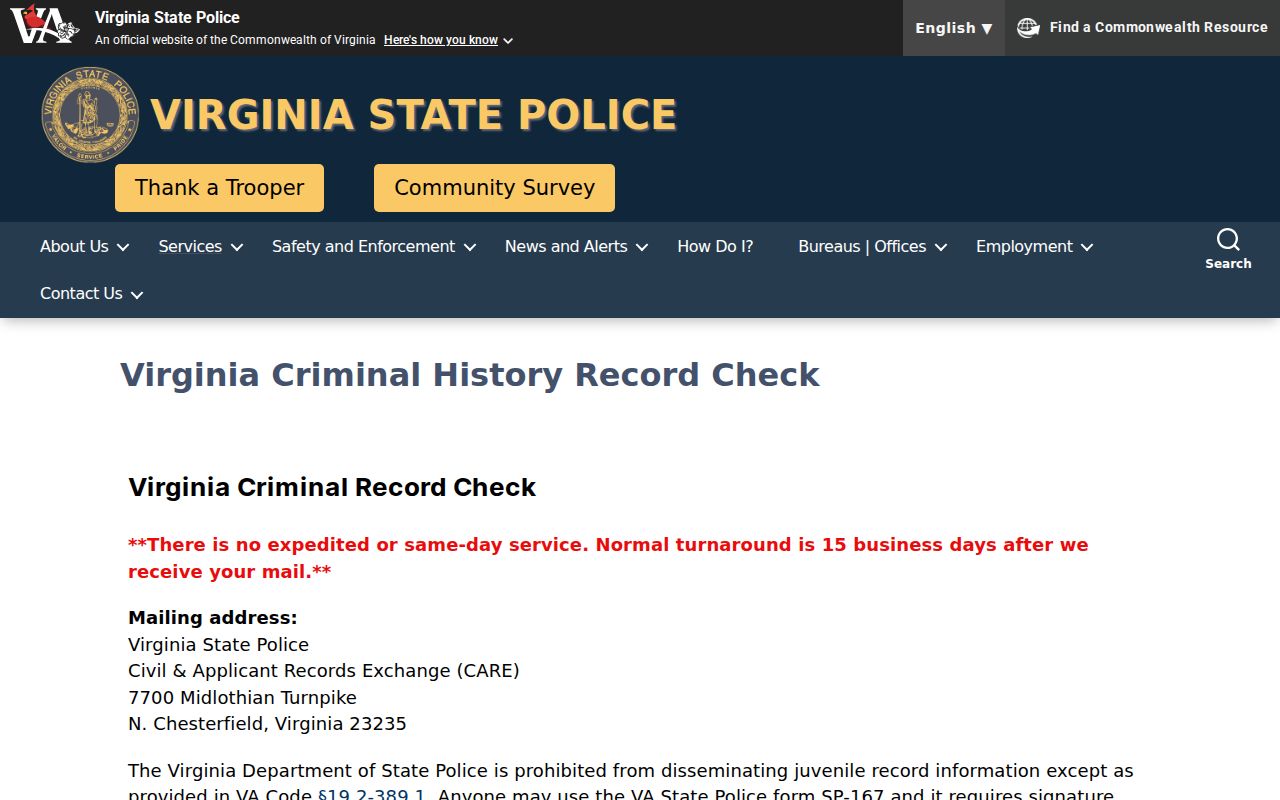
This source confirms that a state report follows a form, consent, notarization, payment, and processing path.
Albemarle SP-167 Form Fields
The VSP NCJI request interface asks for enough data to identify the subject and route the mailed result. Complete the form carefully, then print and notarize it as directed. Missing identity or recipient data can keep the request from moving forward.
| Field group | What to provide | Why it matters |
|---|---|---|
| Request | Form, request type, purpose | Controls the lawful route |
| Identity | Name, race, sex, birth date, SSN status | Supports the name match |
| Recipient | Name or agency and mailing address | Sets where VSP sends results |
| Payment | Method and account data if used | Completes the order |
| Output | Confirm, then generate | Creates the printable form |
The live NCJI screen displays the actual input sequence used for an Albemarle County criminal record request.
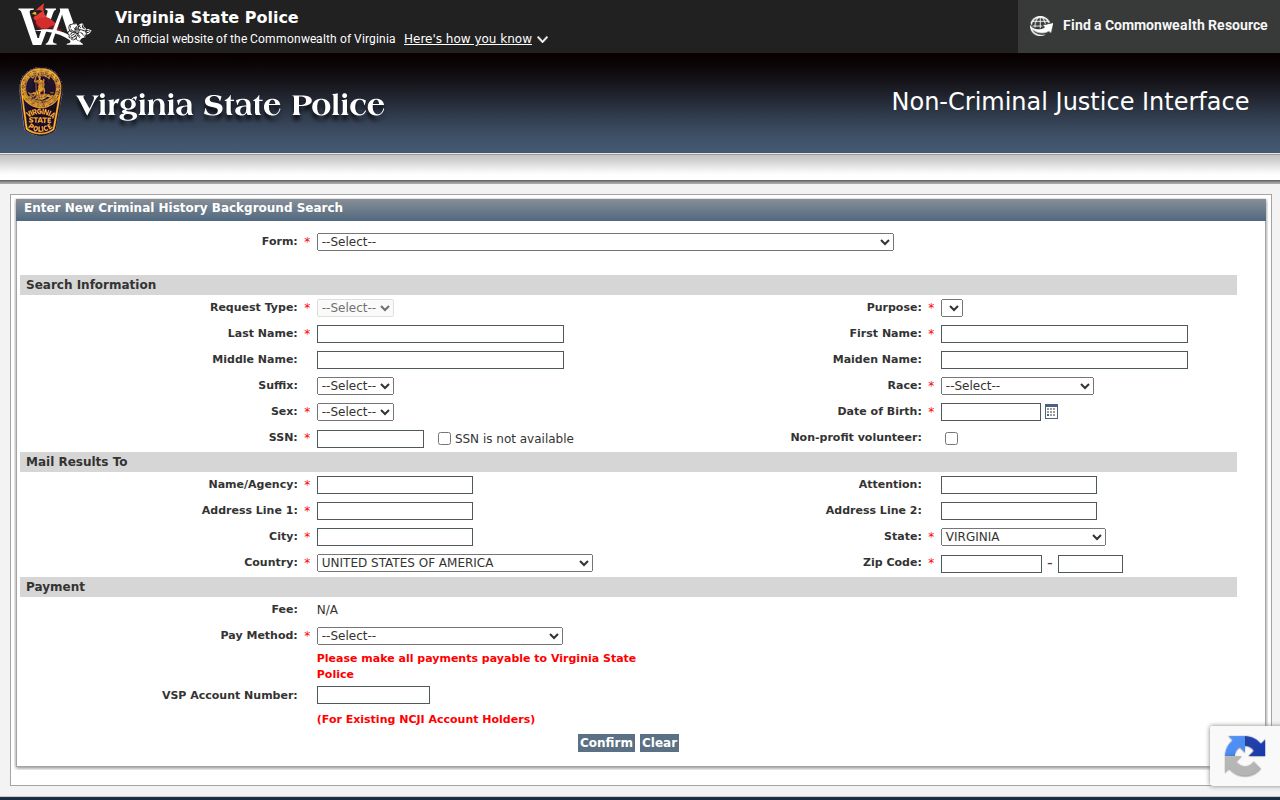
The generated document still needs the required signatures, notarization, and delivery to VSP CARE.
Types of Criminal Records
An Albemarle County arrest can produce several files at once. The arresting police agency creates the incident or arrest report. ACRJ opens a booking file. A magistrate or court creates warrant and bond records. General District Court starts a case for a misdemeanor or felony preliminary stage. A certified felony then moves to Circuit Court under a different case number. CCRE may link the arrest cycle and later court disposition in a Virginia criminal history.
- Police record: incident facts, alleged offense, involved roles, and material the agency may lawfully release.
- Booking record: intake, charges received, bond or holds, custody status, and release administration.
- Court file: filed charge, hearings, plea, motions, outcome, sentence, and financial entries.
- State history: identity-linked arrest cycles and reported dispositions held by CCRE.
- Registry or supervision record: purpose-limited data held by VSP or VADOC.
The VSP forms library helps distinguish SP-167 from other state request forms.
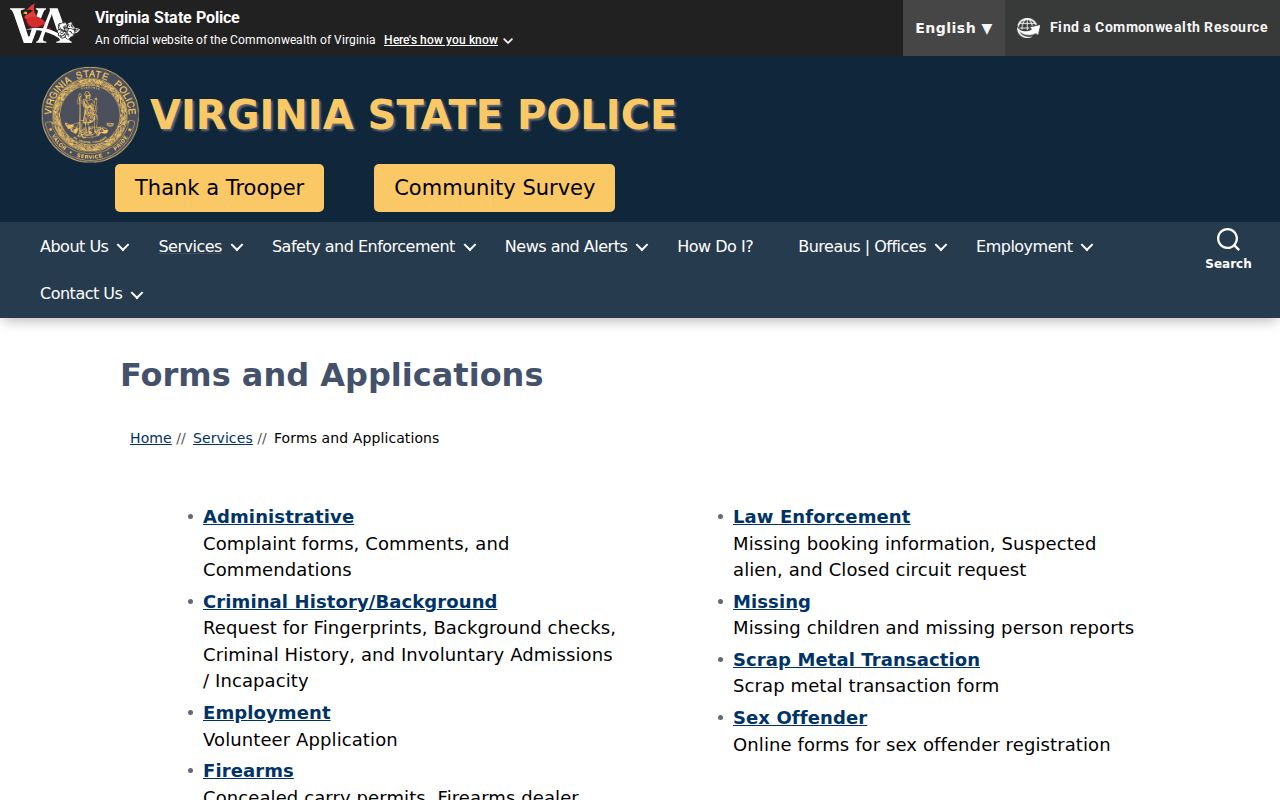
Choosing the right form matters because each state product has its own permitted use and submission rules.
Albemarle Custody Record Tools
ACRJ is the local custody source for Albemarle County, Charlottesville, and Nelson County. Its file is separate from both the ACPD incident report and the court judgment. ACRJ links the public to Virginia VINE for custody status and notifications. If VINE returns no match, call ACRJ Records. A person may have been released, transferred, booked elsewhere, or indexed in another way.
For state custody or community supervision, use the VADOC Inmate and Supervisee Locator. It is updated daily and includes state prisoners, probationers, and parolees within its coverage. VADOC itself warns that data can be inaccurate or out of date, so a court order remains the source for the sentence.
The official locator separates VADOC status from the regional jail’s booking record.
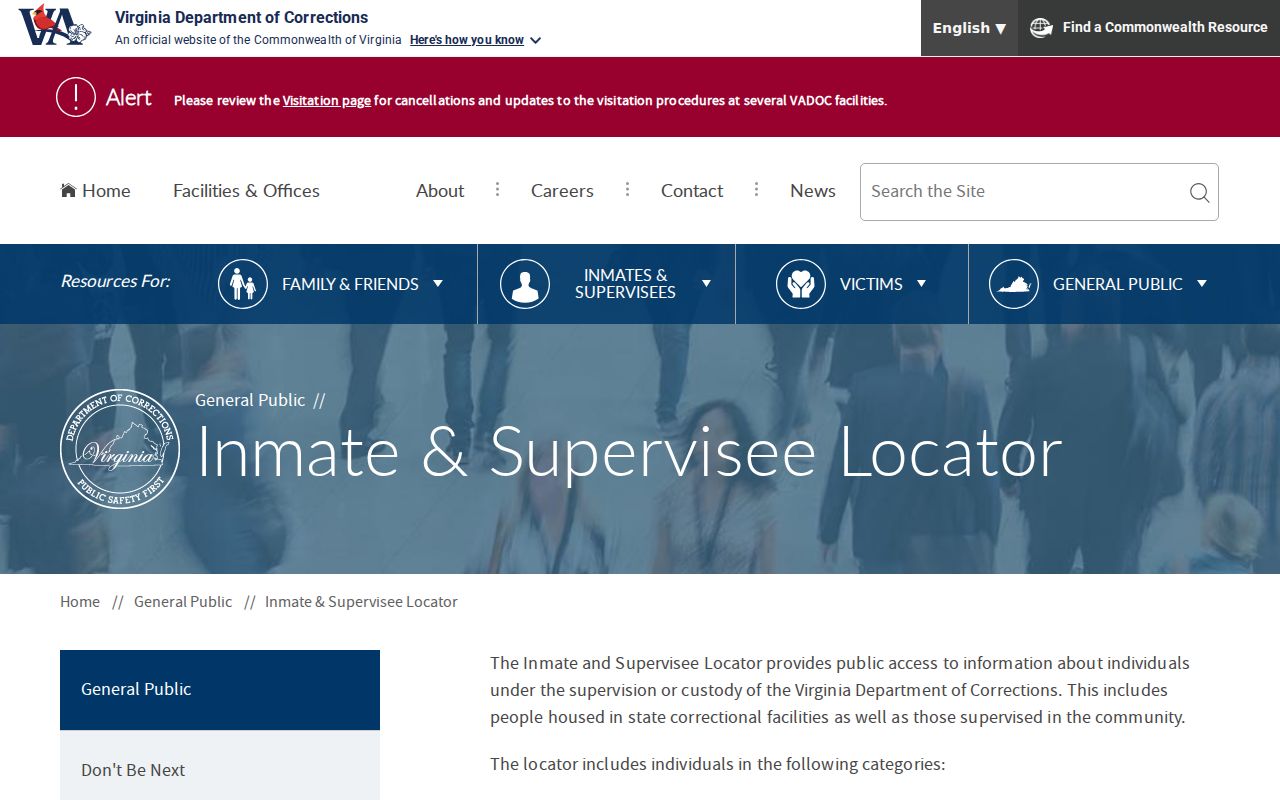
This daily status tool is most useful after a person enters state custody or District 9 supervision.
Note: ACRJ cannot release a person until actual orders arrive from every court, which can take several days.
What an Albemarle County Criminal Record Shows
Each Albemarle County record is organized around its own event. A court file centers on one case number. A booking file centers on one custody episode. A CCRE report centers on identity and arrest cycles. Charge wording can differ across them because an intake allegation may later be amended, declined, dismissed, or replaced by the final judgment.
| Name and identifiers | Identity data used to distinguish the subject, with sensitive values limited in public views. |
|---|---|
| Arrest or booking | Agency, dates, intake identifiers, charges received, bond, holds, and custody status where reported. |
| Charges and statutes | Alleged or filed offense wording, Virginia Code section, and case-specific charge data. |
| Disposition | Plea, dismissal, nolle prosequi, acquittal, conviction, or other recorded outcome. |
| Sentence | Incarceration, suspended time, probation, fine, costs, and restitution when ordered. |
| Supervision status | VADOC custody, probation, or parole status within the locator’s public limits. |
Victim data, Social Security numbers, juvenile identities, sealed material, and sensitive investigative details are not ordinary public fields. The underlying clerk, police agency, or VSP record controls over a saved portal screen.
Albemarle Criminal Cases at Court Square
Albemarle General District Court and Albemarle Circuit Court share the 350 Park Street address, yet they maintain distinct records. GDC handles adult misdemeanors, traffic cases, advisements, and felony preliminary hearings. Its felony preliminary docket usually meets on Thursday mornings. When GDC marks a felony charge “certified,” the notation means the matter was sent toward the grand jury and Circuit Court. It is not a conviction.
Circuit criminal terms begin in February, April, June, August, October, and December, with the grand jury on the first day of term. That rhythm helps explain why a GDC entry can appear before its related Circuit file. Select Albemarle, not Charlottesville, in the court portals even though the courthouse mailing city says Charlottesville. For a deeper view of filed charges and outcomes, use the Albemarle County criminal court case records route.
Visitors should also expect security screening. GDC states that cell phones are secured and unavailable unless the court permits access, so write down the case number before going to the clerk’s counter.
Public Access Laws
Virginia law treats each Albemarle County record type differently. VFOIA creates a request and response process for covered public records, but it does not make every police narrative public. Court clerks follow judiciary access law. CCRE dissemination has its own limits. Registry data is released for a defined public-safety purpose.
Key Virginia statutes:
Virginia Code § 2.2-3704 sets the five-working-day VFOIA response framework and actual-cost rules.
Virginia Code § 2.2-3706 governs access to law-enforcement records and investigative material.
Virginia Code § 19.2-389 limits who may receive CCRE criminal-history information and why.
Virginia Code § 17.1-208 addresses clerk access, copies, and lawful court-record fees.
Albemarle County must respond to a valid VFOIA request within five working days or use a lawful response, including a seven-working-day extension when needed. Costs may include actual search and duplication work. The county may seek a deposit when an estimate exceeds $200.
Albemarle Criminal Record FOIA Route
The county’s online VFOIA form accepts targeted requests for existing records. Choose the right department. Police and Fire requests go to Alison Wood at ACPD, while Commonwealth’s Attorney material uses that office’s contact. Include an incident or case number, a date range, the record type, and the agency. Ask for electronic delivery and an estimate when cost matters.
| Channel | Key condition | Published cost or time |
|---|---|---|
| ACPD incident copy | Named reporting party or victim with photo ID | Pickup or mail; no email or fax |
| County VFOIA | Existing, described public record | Five-day framework; actual cost |
| ACRJ Records | Booking or release question | Published office hours; copy fee not stated |
| VSP SP-167 | Notarized consent and form | $15 or $20; about 15 business days |
ACPD’s ordinary incident-copy service is narrower than VFOIA. Uninvolved people cannot use the party-or-victim counter route. Full officer notes or narratives may also be withheld under Virginia law.
Sealed, Expunged & Restricted
Juvenile and J&DR records, protected victim data, sealed cases, expunged matters, and exempt investigative content do not appear like ordinary public Albemarle County criminal records. ACPD requires a court order even when a parent seeks a juvenile police report. Virginia Judiciary does not publish J&DR case detail through its public search.
Virginia expungement under § 19.2-392.2 can cover qualifying acquittals, nolle-prossed charges, dismissals, and mistaken identity. An Albemarle petition is filed in Circuit Court where the case ended, even when the original misdemeanor was in GDC. Virginia’s sealing chapter is a separate framework with automatic and petition routes for listed matters. Its staged effective dates make the filing date important.
A missing online result does not prove that a record was sealed. It can also mean the wrong court was chosen, an entry is new, the name was indexed differently, or an old file is not online. Keep any certified relief order, allow time for agency processing, and use one’s own SP-167 report as a limited state-history check.
Albemarle Criminal Records Beyond Virginia
Virginia court portals do not contain federal cases. Albemarle County lies in the U.S. District Court for the Western District of Virginia, and PACER is the official electronic federal docket channel. Registration and usage fees can apply. Sealed federal matters remain unavailable through PACER.
The official PACER home screen is the starting point for known federal filings.
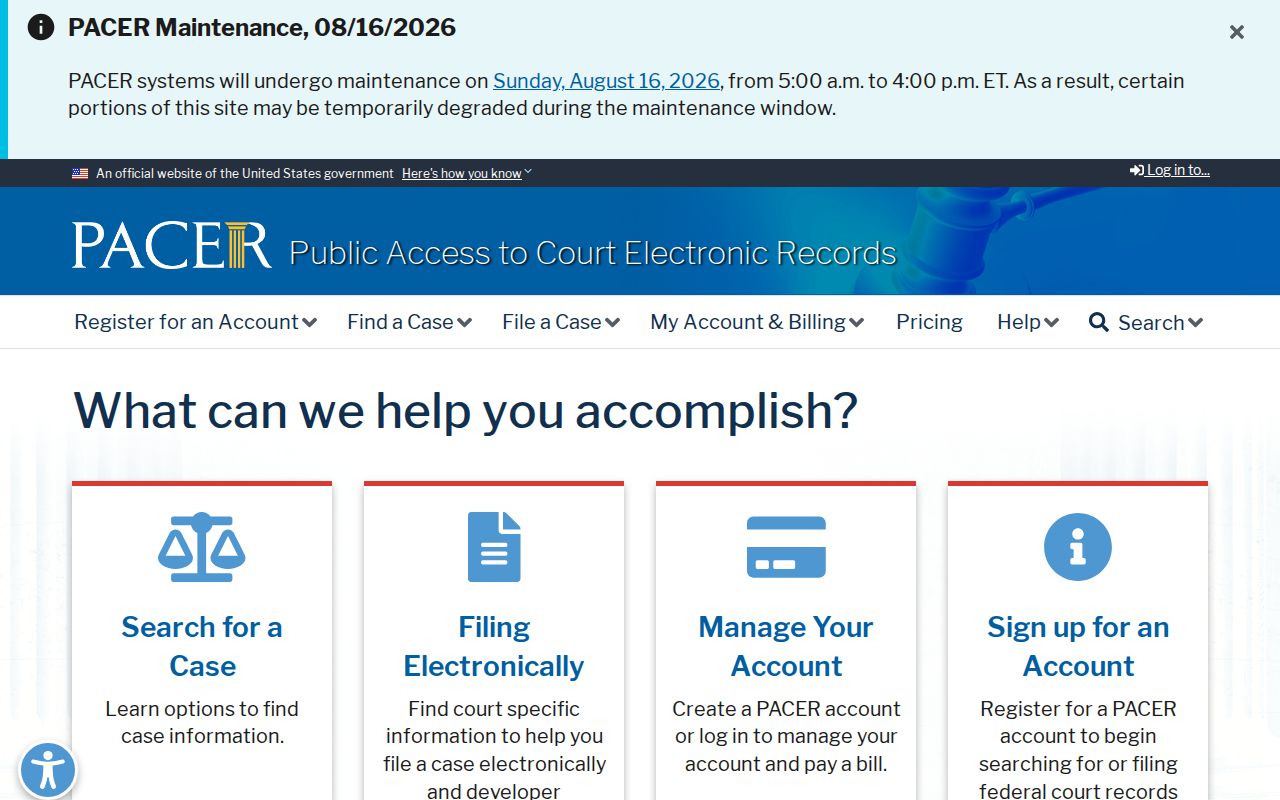
This route should not be confused with Albemarle GDC or Circuit searches, which cover Virginia court matters.
For one’s own national fingerprint history, the FBI Electronic Departmental Order process is broader than SP-167. It requires the subject’s fingerprints and the FBI fee, currently listed as $18 but best confirmed when ordering.
The EDO interface shows the federal self-review order path.
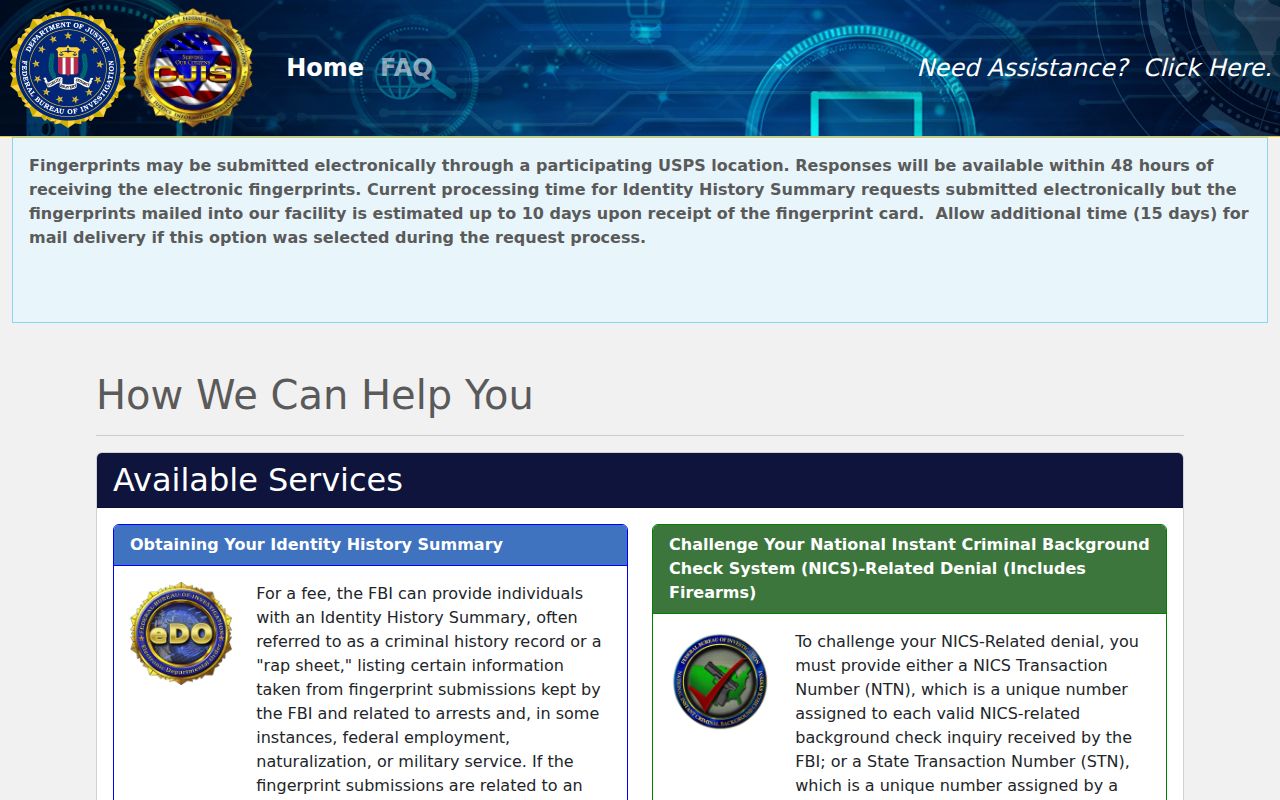
An FBI Identity History Summary is access to one’s own record, not a public name search for another person.
Albemarle Criminal Record Terms
Virginia docket language can make an Albemarle County search seem final when the case is still moving. Read the status in the context of the court and stage.
- Certified
- GDC found probable cause and sent a felony charge forward toward Circuit Court; this is not a conviction.
- Nolle prosequi
- The prosecution declined to proceed with that charge at that time; it is not a finding of innocence.
- Disposition
- The recorded outcome for a charge or case, such as dismissal, acquittal, or conviction.
- Capias
- Court process directing an arrest, often tied to a failure to appear or alleged noncompliance.
- Sealing
- A statutory limit on public access under Virginia’s separate Chapter 23.2 process.
For any result that matters, obtain the order from the clerk and compare it with the police or CCRE record that is in question.
Criminal Records by City in Albemarle County
Scottsville is Albemarle County’s only incorporated municipality. Charlottesville is an independent city and is not part of Albemarle County government. A Scottsville police report begins with the Town, but adult charges go through Albemarle GDC and Circuit Court, bookings go to ACRJ, and statewide identity history goes to VSP. The town has no separate municipal court or city jail.
Scottsville Criminal History
Town police reports, Albemarle court routing, ACRJ custody, and Virginia record checks
Use the Scottsville page for town-level routing without borrowing ACPD contacts or choosing Charlottesville in the state court search.
Albemarle Arrest-to-Record Flow
An Albemarle County record changes as a case moves. The police allegation comes first. ACRJ may then show custody before the prosecutor settles on the filed charge. GDC records the preliminary or misdemeanor stage. Circuit handles a certified or indicted felony. Courts and criminal-justice agencies later report dispositions to CCRE.
Record flow: Arresting agency → ACRJ booking → Magistrate and GDC → Circuit Court when applicable → VSP CCRE disposition link.
Timing and identity mismatches can leave gaps. A court portal is not a substitute for SP-167, and SP-167 is not a substitute for the police narrative or a certified court order. When a state history appears wrong, inspect the court file and arresting-agency record first. VSP directs a person disputing an arrest segment back to the arresting agency.